
This post first appeared on March 2, 2021 at AEIdeas. AEIdeas is a public policy blog from the American Enterprise Institute (AEI).
The Child Tax Credit (CTC) is all the rage these days. Democrats and Republicans both are advancing proposals to increase the maximum value of the CTC and make it available to more families. The $1.9 trillion American Rescue Plan passed by the House of Representatives includes a temporary, one-year child tax credit expansion worth over $100 billion. This policy is a modified version of a proposal advanced by President Biden. Republicans already doubled the CTC in 2017, and recently Senator Romney (R-UT) has advanced his own proposal to expand the credit. These proposals follow more than two decades of incremental expansion of the CTC, which was first enacted in 1997 and valued at $500.
In a recent AEI report, The tax benefits of parenthood: A history and analysis of current proposals, we analyze a set of tax provisions which provide targeted tax relief to parents including the child tax credit, the earned income tax credit, the dependent exemption (scheduled to return in 2026), the head-of-household filing status, and the child and dependent care tax credit. Together, these policies are worth $209 billion annually, and the CTC comprises more than half of that ($114 billion). We find that the proposals advanced by President Biden, the House of Representatives, and Senator Romney would expand the total value of child tax benefits, make the tax code more progressive, and reduce poverty, but they would also reduce work incentives by raising marginal tax rates.
We have developed a web application to accompany our recent report. Design Your Own Child Tax Credit Reform allows any user to compare popular current proposals or choose the parameters of their own preferred custom CTC reform. Available policy levers include the maximum credit value ($2000-$3500), an additional credit for children under six ($0-1000), partial or full refundability, and a choice of credit phase-out rules.
The tool provides estimates of how these proposals impact the total value of child benefits, the budgetary impact of the Child Tax Credit, poverty rates, the average value of child tax benefits, and the impact on marginal effective tax rates for households with children. The estimates are based on a large database of anonymized tax returns and a detailed model of the federal individual income tax.
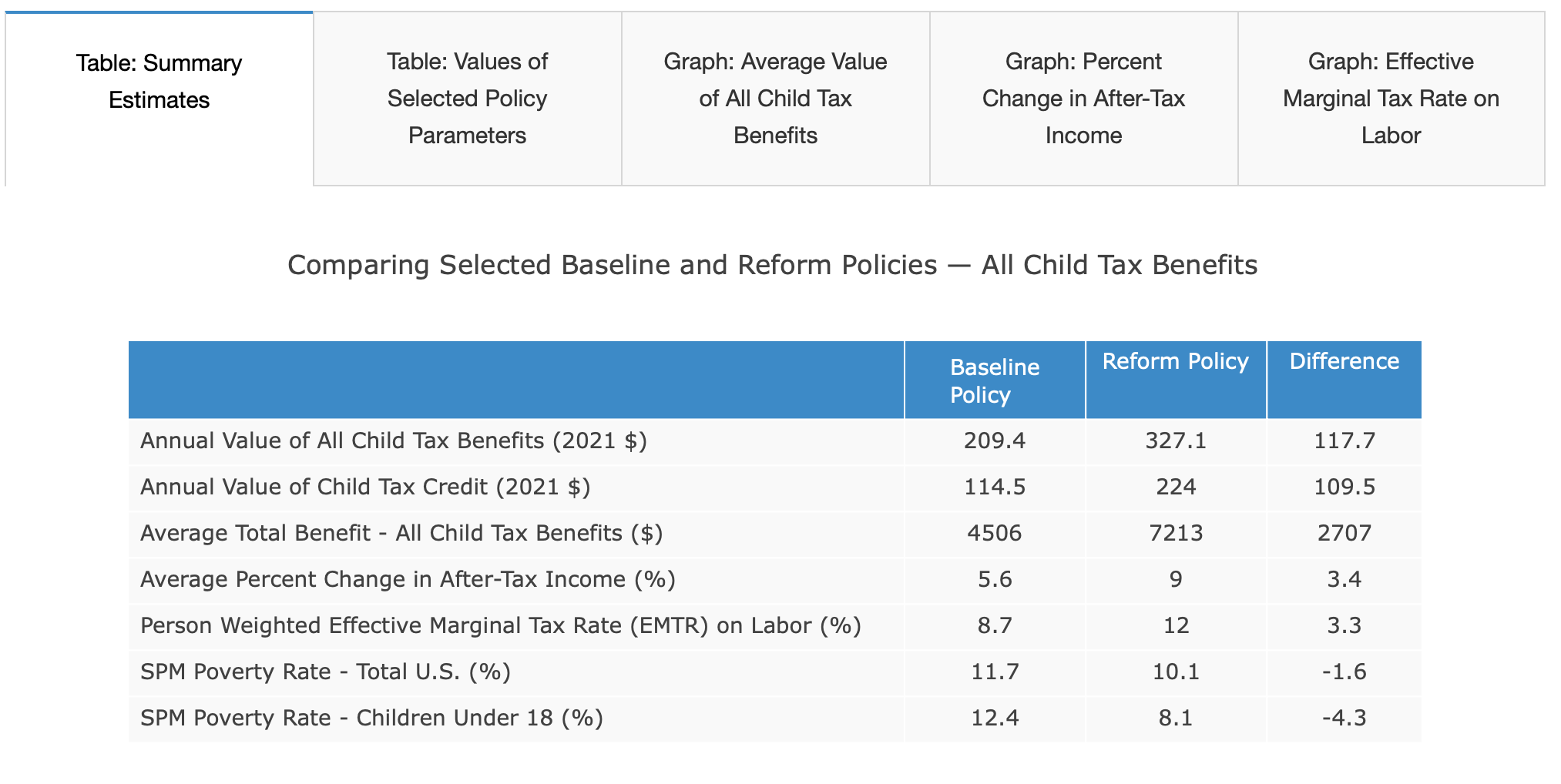
Below is a snapshot of one output presented by the web app. Here we are comparing current law (Baseline Policy) to the child tax credit reform in Senator Romney’s Family Security Act (Reform Policy).
Example of the Web App Output: Current Policy vs. Senator Romney’s Child Tax Credit Plan
We hope this tool encourages students, lawmakers, and ordinary voters alike to explore the trade-off and impacts of various child tax credit expansion options. Don’t settle for just the policies advanced by others — pick your child tax credit!
You can access the web application here.
Citation
@misc{brill2021,
  author = {Brill, Alex and Pomerleau, Kyle and Seiter, Grant M.},
  publisher = {American Enterprise Institute},
  title = {Pick {Your} {Child} {Tax} {Credit}},
  date = {2021-03-02},
  url = {https://www.aei.org/economics/pick-your-child-tax-credit/},
  langid = {en}
}